
Belladonna Homeopathic Medicine: Uses, Symptoms, Materia Medica & Safety
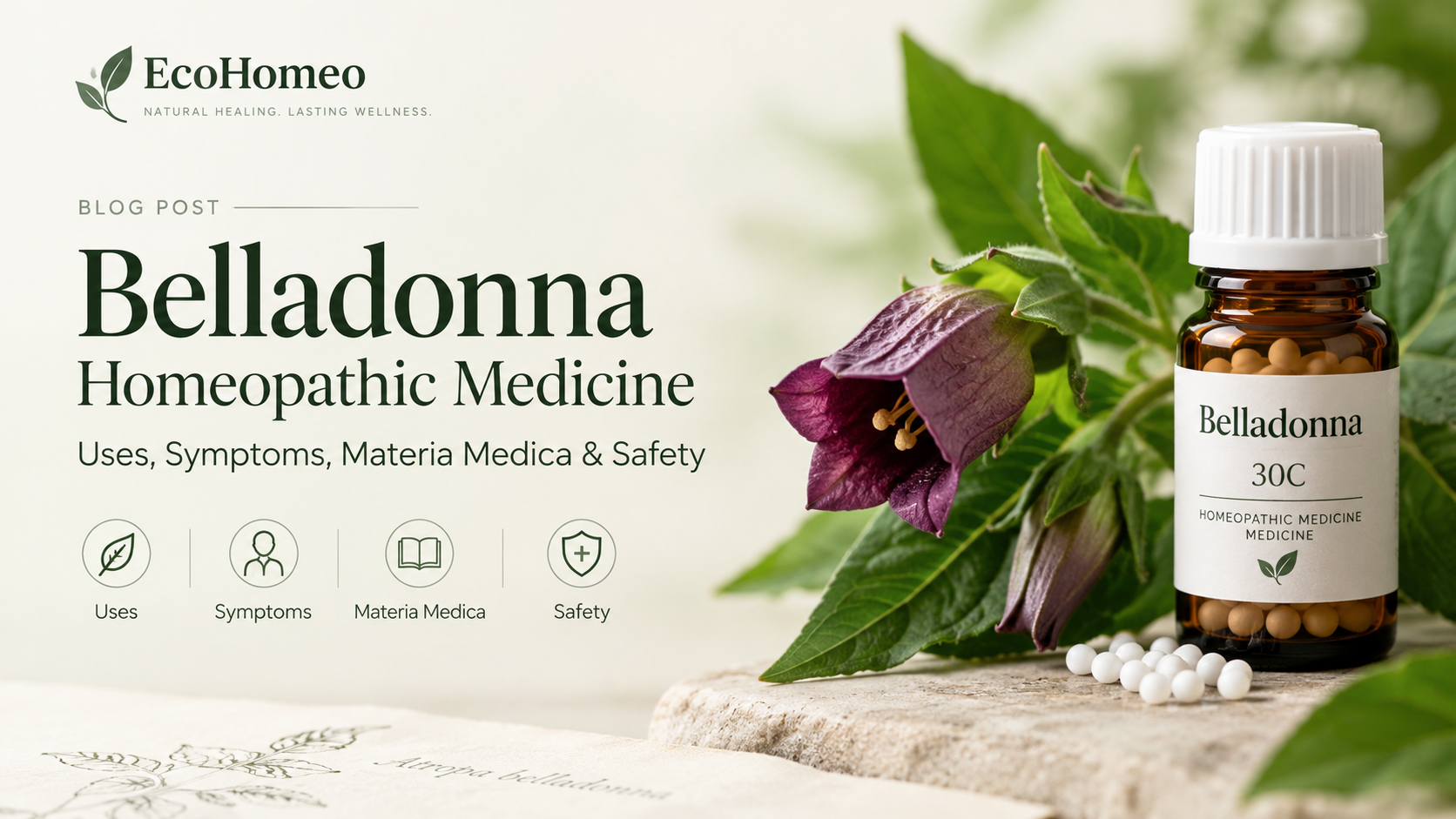
Belladonna homeopathic medicine is made from Atropa belladonna (deadly nightshade). Classical materia medica describes the remedy as the remedy of sudden and violent onset, with burning heat, redness, throbbing pain, dilated pupils and extreme sensitivity to light, noise, touch and jarring. It is traditionally linked with fever, headache, earache, sore throat and inflamed skin or breast. These are teachings from homeopathic texts. Clinical trials have not shown homeopathic dilutions to work better than placebo, and the raw plant is highly poisonous.
How to read this guide: Symptom descriptions come from classical homeopathic literature, mainly William Boericke's Materia Medica (1901), James Tyler Kent's Lectures on Homoeopathic Materia Medica and John Henry Clarke's Dictionary of Practical Materia Medica. They show how homeopaths have understood the remedy and are not claims confirmed by modern medicine. Where the evidence or safety picture is different, this guide says so.
Belladonna in 60 Seconds
| Also known as | Bell.; Atropa bella-donna; Deadly nightshade; Tollkirsche (German) |
| Preparation | Tincture of the whole plant when beginning to flower (Clarke), followed by serial dilution and succussion |
| Common forms | Pellets, tablets and liquid dilutions, commonly 6C, 30C and 200C |
| US regulatory status | Homeopathic drug; not evaluated by the FDA for safety or effectiveness |
| Evidence status | No reliable clinical evidence of effect beyond placebo |
Homeopathic Belladonna is not the same as the raw plant or as atropine. High homeopathic potencies (12C and above) are diluted beyond the point where any plant molecule is expected to remain.

The 12 Classical Indicators of Belladonna
Boericke summed up the remedy in two words: violence of attack and suddenness of onset. These twelve indicators come from his text and from Clarke.
Sudden, Violent Onset
Complaints arrive abruptly and intensely, often within hours, with a feeling of storm and congestion.
Heat, Redness, Throbbing, Burning
Boericke gives these four as the central signs: hot red skin, flushed face and throbbing, burning pains.
Hot Head, Cold Feet
Burning heat of the head and body with icy cold feet and cold extremities, and distended surface veins.
Dilated Pupils, Staring Eyes
Wide pupils, a staring brilliant look, red conjunctiva and photophobia (light sensitivity).
Acute Sensitivity of All Senses
Hyperesthesia to light, noise, touch, jarring and draughts, so a step on the floor can worsen the pain.
Great Dryness of Mucous Membranes
Dry nose, mouth, tongue, throat and chest. Thirst is reported differently: Boericke says none in fever, Kent says water little and often and a craving for lemons.
Pains That Come and Go Suddenly
Neuralgic pains that appear abruptly and vanish abruptly, including labor-like pains.
Delirium and Visions
In acute states, frightening visions of monsters or hideous faces, rage, biting, striking and a desire to escape.
Right-Sided Tendency
Red throat, headache, ovarian pain and pleurisy lean to the right in Boericke's and Kent's texts.
Smooth Scarlet Skin
Dry, hot, smooth, scarlet skin with an eruption like scarlatina that spreads suddenly.
Worse Touch, Jar, Motion
Even the jar of the bed makes the pain worse. Better from rest and a semi-erect posture, and the person wants to be kept warm.
Starting in Sleep
Starts as if from an electric shock on falling asleep, with violent dreams, crying out, grinding the teeth and a drowsy but sleepless state.
The Belladonna Picture in Classical Texts
Boericke calls Belladonna a great children's remedy. He describes a high feverish state with comparative absence of toxaemia, which means the person looks very ill and feverish yet is not yet deeply poisoned or exhausted. This is why the remedy is classically linked with the early, hot, inflammatory stage of an illness rather than its late, exhausted stage.
- Hot, red, bluish-red or shining face with throbbing carotid arteries
- Hot dry skin with icy cold feet and cold extremities
- Wide pupils and a glaring brilliant look
- Extreme sensitiveness to touch, jar, noise and draught
- Boericke: "Great children's remedy" and "no thirst, anxiety or fear"
- Clarke links it with the other nightshades: Capsicum, Dulcamara, Lycopersicum, Hyoscyamus and Stramonium
- Boericke lists Calcarea carbonica as its complementary remedy, especially for semi-chronic and constitutional cases
What Kent Adds: How Belladonna Behaves
James Tyler Kent's lectures describe the behavior of the remedy, which is often more useful than a symptom list. These points are his teaching from the early 1900s and are presented here as classical homeopathic doctrine.
- Kent says it suits vigorous, plethoric, brainy people who fall ill suddenly while in good health
- He describes plump, large-headed children who take cold easily and get headaches
- The complaint comes on suddenly, runs a sharp course, and subsides suddenly
- He says its fever is remittent and not continued, so it is not the remedy for gradual, typhoid-type fevers
- Complaints follow exposure of the head: uncovered head in cold air, a haircut, a wet head
- They travel downward, from the head to the chest, abdomen, uterus or limbs
- Aconite and Pulsatilla complaints, Kent says, come from wet feet and travel upward
- Rhus complaints appear in the part that got wet
Kent builds the picture around three leading features, heat, redness and burning, then adds swelling and throbbing. He says the heat is so intense that a hand placed on the person is withdrawn and the memory of the heat stays in the fingers. The skin is first bright red and shiny, then may turn dusky and mottled as the illness advances. In the old texts the skin was also said to show a white line for a moment when a fingertip is stroked across it, a historical sign of scarlatina.
Kent warned that Belladonna is an acute remedy of limited depth. It does not fit complaints that recur in a series, and he says that when the same attack returns, a deeper remedy such as Calcarea carbonica is often needed. In Boericke's text the same relationship appears as "Calcarea is often required after Belladonna."
Mind and Emotional State
- Visions and hallucinations: sees monsters and hideous faces and is absorbed in spectres, unaware of the real surroundings.
- Furious delirium: rages, bites, strikes and wants to escape, with frightful images.
- Acuteness of all senses: every impression is felt too strongly.
- Changeableness: perversity, tears, and being disinclined to talk.
- Loss of consciousness is also listed in the most severe states.
- Always active, never passive (Kent): there is no passive delirium in Belladonna; the state is wild, with striking, biting and tearing things.
- Starting and fear: starts in fright when others approach, and starts like an electric shock on falling asleep.
- Aversion to light and noise, and Kent notes the delirium is often eased by a little light food.
Delirium, hallucinations, violent behavior and confusion need urgent medical assessment. They can come from serious infection, meningitis, poisoning or other emergencies, and are never a reason to wait for a homeopathic remedy to act.
Belladonna Symptoms by Organ and Body System
This is the symptom picture recorded in Boericke's Materia Medica, grouped by body system.
Head and Headache
- Throbbing and heat, with fullness especially in the forehead, back of the head and temples
- Pain worse from light, noise, jar, lying down and in the afternoon; better from pressure and a semi-erect posture
- Kent: pressure helps when applied gradually, as with a bandage or tight cap; drawing the head back may ease it; bending forward, stairs and moving the eyes make it worse
- Boring of the head into the pillow, with moaning
- Headache worse on the right side; ill effects from having the hair cut; hair dry and falling out
Eyes
- Dilated pupils; staring, brilliant eyes with red conjunctiva
- Eyes feel swollen and protruding, dry and burning
- Photophobia, double vision, squinting and spasms of the lids
- Throbbing deep in the eyes on lying down
Ears
- Otitis media: throbbing pain deep in the ear, in time with the heartbeat
- Pain so severe it causes delirium; child cries out in sleep
- Hearing very acute and sensitive to loud tones
- Humming noises; eardrum described as bulging and injected
Face and Nose
- Face red, bluish-red, hot, swollen and shining
- Facial neuralgia with twitching muscles and a flushed face
- Nosebleed with a red face; mucus mixed with blood in coryza
- Swelling of the upper lip
Mouth and Throat
- Mouth, tongue and throat dry; tongue red on the edges, with a strawberry tongue
- Throat dry as if glazed, angry red congestion, worse on the right
- Tonsils enlarged; throat feels constricted; swallowing difficult, worse for liquids
- Spasms in the throat; grinding of the teeth; throbbing toothache
Voice and Chest
- Tickling, short, dry cough, worse at night
- Larynx sore and very painful, as if a foreign body were in it
- Hoarseness or loss of voice; a high, piping voice
- Barking cough and whooping cough; quick, oppressed breathing
Stomach
- Loss of appetite with aversion to meat and milk
- Nausea, vomiting and spasmodic pain in the upper abdomen
- Boericke records both great thirst for cold water and abhorrence of liquids; Kent adds a craving for lemons and water wanted little and often, so the whole picture decides
- Empty retching and spasmodic hiccough
Abdomen and Bowels
- Abdomen distended and hot; pain as if clutched by a hand
- Extreme sensitiveness to touch, even from bed-clothes
- Pain worse from jar and pressure
- Stools thin, green and dysenteric; piles more sensitive
Urinary and Male System
- Urine scanty and dark, or frequent and profuse; retention is also listed
- Sensitive bladder region; acute urinary infections
- Testicles hard, drawn up and inflamed
- Flow of prostatic fluid and diminished desire
Female System
- Menses bright red, too early and too profuse, with clots; the blood feels hot (Boericke and Kent)
- Menses and lochia very offensive and hot
- Sensation as if all the viscera would protrude at the genitals
- Mastitis: throbbing pain, redness and streaks radiating from the nipple; breasts heavy, hard and red. Kent contrasts it with Phytolacca for glands inflamed without general symptoms
Heart and Circulation
- Violent palpitation that reverberates in the head
- Palpitation from the least exertion
- Throbbing all through the body
- Rapid but weakened pulse
Limbs and Joints
- Joints swollen, red and shining, with red streaks radiating
- Shooting and shifting pains along the limbs
- Stiff neck and swelling of the neck glands
- Jerking limbs and spasms; cold extremities
Skin
- Skin dry and hot, smooth and scarlet
- Eruption like scarlatina, spreading suddenly; erysipelas
- Boils, and glands swollen, tender and red
- Alternate redness and paleness of the skin
Fever and Sleep
- Burning, pungent, steaming heat; feet icy cold; surface veins distended
- Thirst is reported differently: Boericke says none with fever, Kent says water little and often
- Restless sleep, crying out and grinding teeth; starting when closing the eyes
- Sleeplessness with drowsiness; kept awake by pulsation of vessels
Modalities: What Makes Belladonna Worse or Better
- Touch and pressure on the sore part, even bed-clothes
- Jar and jerking, including the jar of the bed
- Motion (Kent)
- Noise and bright light
- Draught, cold air and uncovering the head
- Having the hair cut
- Afternoon; Kent gives about 3 pm, running into the night
- Lying down
- The right side (throat, headache, ovary)
- Semi-erect posture (Boericke)
- Pressure applied gradually, as with a bandage (Boericke and Kent)
- Keeping still and rest (Kent)
- Warmth and being wrapped up warmly (Kent)
- Drawing the head backward, in headache (Kent)
- A little light food, in fever delirium (Kent)
Two exceptions appear in Kent. A tearing pain in the legs from the hips down, with no swelling, may come on at rest and keep the person walking. And in pleurisy Belladonna cannot lie on the painful side, which is the reverse of Bryonia.
Remedy Relationships
| Relationship | Remedies | Source and Context |
|---|---|---|
| Complementary | Calcarea carbonica | Boericke: Calcarea is often required after Belladonna, especially in semi-chronic and constitutional diseases. Kent says the same for recurrent attacks in plump, large-headed children. |
| Antidotes | Camphor Coffea Opium Aconite | Listed by Boericke as antidotes to Belladonna. Kent adds that Opium and Belladonna often antidote each other, and that Calcarea antidotes the effects of too much Belladonna. |
| Incompatible | Acetic acid | Boericke lists acetic acid as incompatible. |
| Follows well | Arsenicum Chamomilla Hepar Lachesis Mercurius Phosphorus Nitric acid Cuprum | Clarke: remedies that follow Belladonna well. |
| Followed well by | China Chamomilla Conium Dulcamara Hepar Hyoscyamus Lachesis Rhus tox Senega Stramonium Valerian Veratrum | Clarke: remedies that Belladonna is followed by well. |
| Compare | Hyoscyamus Stramonium Capsicum Dulcamara Lycopersicum | Other nightshades (Solanaceae), as grouped by Clarke and Boericke. |
Boericke's own contrasts are short and useful: Hyoscyamus has less fever and more agitation, and Stramonium has more sensorial excitement and frenzy.
Belladonna vs Aconite, Apis, Bryonia and Gelsemium
Many remedies cover acute fever, and homeopaths separate them by onset, mind, thirst, warmth and modalities. This is the most practical part of the materia medica.
| Feature | Belladonna | Aconite | Apis | Bryonia | Gelsemium |
|---|---|---|---|---|---|
| Onset | Sudden and violent | Sudden, after cold dry wind or fright | Rapid, with swelling | Slow, over days | Slow, often after anticipation or dread |
| Mind | Wild, active delirium; visions; "no anxiety or fear" in fever (Boericke) | Intense fear, fear of death, restlessness | Irritable, jealous, tearful, clumsy | Irritable; wants to be left alone | Dull, droopy, drowsy, trembling |
| Thirst | Authors differ: none (Boericke) or little and often (Kent) | Intense thirst for cold water | Thirstless; Kent: "no thirst to speak of" | Large draughts at long intervals | Not a leading feature |
| Warmth | Wants to be warm and wrapped up (Kent) | Worse from sudden temperature change | Wants to be cool and uncovered (Kent) | Worse from heat, better from cold things | Worse from heat and damp, humid weather |
| Skin and mucous membranes | Hot, dry, smooth scarlet | Hot, dry | Swollen, stinging, burning; rough rash (Kent) | Dry mucous membranes; parched, cracked lips | Flushed, heavy face; drooping eyelids |
| Key modality | Worse touch, jar, motion; better semi-erect, rest, warmth | Worse around midnight to 4 a.m.; sudden temperature change | Worse heat and touch; better cold | Worse any motion; better rest, pressure, lying on the painful side | Worse emotional upset and bad news; better after profuse urination |
Belladonna vs Aconite
Both begin suddenly, which is why they are confused. The classical shorthand is that Aconite is anguish and Belladonna is congestion. Aconite is dominated by fear, often of death, and is linked to cold dry wind or fright. Belladonna shows burning heat, throbbing, wide pupils and wild delirium without that fear. Kent adds a direction: Aconite and Pulsatilla complaints follow wet feet and rise upward, while Belladonna follows exposure of the head and travels downward.
Belladonna vs Apis
Kent contrasts them in scarlet fever. Apis has a rough rash, wants to be cool and uncovered, and has little thirst. Belladonna has a smooth, shining scarlet skin and wants to be warm. Apis centers on swelling, stinging and burning with a watery, puffy look, while Belladonna centers on congestion and throbbing.
Belladonna vs Bryonia
Both are worse from motion, and Kent says Belladonna is as averse to motion as Bryonia. The difference is speed and sensitivity. Bryonia comes on slowly, is better for pressure and for lying on the painful side, and is less sensitive to jarring. Belladonna comes on suddenly, has intense heat and throbbing, and cannot bear touch or the jar of the bed. In right-sided pleurisy Kent says Belladonna cannot lie on the painful side, while Bryonia lies on it.
Belladonna vs Gelsemium
Gelsemium is the slow, heavy picture: droopy eyelids, drowsiness, dullness and trembling, often after a period of anticipation or dread. Belladonna is flushed, bright, hot and sensitive. One feels relaxed and paralytic, the other congested and excited.
Belladonna vs Stramonium, Hyoscyamus and Opium
These cover violent delirium too. Boericke separates them in one line: Hyoscyamus has less fever and more agitation, and Stramonium has more sensorial excitement and frenzy. Kent contrasts Belladonna with Opium, which looks similar in the face and eyes but deadens sensitivity. In Belladonna, he says, the more the congestion the more the excitability, while in Opium the more the congestion the less.
Belladonna Homeopathic Medicine Uses and When to See a Doctor
| Complaint | Belladonna keynotes in the old texts | See a doctor if |
|---|---|---|
| Fever | Sudden, high, burning dry skin, red face, wide pupils, no thirst | Baby under 3 months with a fever of 38 C (100.4 F) or higher; stiff neck, confusion, seizure, a rash that does not fade when pressed, or trouble breathing |
| Headache | Throbbing, congestive, worse jar, light and lying down | Sudden severe headache, headache after injury, or with fever and stiff neck |
| Earache | Sudden, throbbing, hot red ear, noise-sensitive | Fever, discharge, a child under 2, or pain lasting more than a day or two |
| Sore throat | Bright red, dry, right-sided, painful swallowing | Trouble swallowing or breathing, drooling, or fever for more than two or three days |
| Breast inflammation | Hot, red, hard breast with streaks from the nipple | Always, particularly with fever or flu-like symptoms |
| Heat exhaustion | Hot red face and throbbing head after sun exposure | Confusion, fainting, vomiting or a body temperature of 40 C (104 F) or higher is an emergency |
Potency, Dosing and How Belladonna Is Sold
- 6C and 12C: lower potencies used in traditional practice for frequent repetition. At 12C the dilution is near the limit beyond which no molecule is expected to remain.
- 30C: the common retail potency, and the one Boericke names for scarlet fever prevention in his day.
- 200C: a higher potency usually chosen by practitioners for cases that closely match the picture.
- Mother tincture and 1X to 3X: these still contain plant material and are not appropriate for self-treatment.
Belladonna 30C vs Belladonna 200C
| Potency | How it is used in homeopathic practice | What to know |
|---|---|---|
| Belladonna 30C | The usual retail potency for self-care products, and the one Boericke names for scarlet fever prevention | Not expected to contain any plant material. Follow the label. |
| Belladonna 200C | A higher potency generally chosen by practitioners for cases that closely match the picture | No controlled trial shows a difference from 30C. It is not a stronger dose in the pharmacological sense. |
Boericke's dosing note reads, in summary: from the first to the thirtieth potency and higher, repeated frequently in acute diseases. That is a historical statement. This guide gives no dose. Follow the directions on the product label, and ask a doctor or pharmacist before giving any remedy to a child, or using one in pregnancy or breastfeeding.
Scientific Research and Clinical Evidence
Belladonna is one of the few homeopathic remedies tested in healthy volunteers (provings). The results do not support a pharmacological effect of the diluted remedy:
- Brien, Lewith and Bryant (2003) ran a randomized, double-blind, placebo-controlled proving trial of Belladonna 30C, and the paper's title states that ultramolecular homeopathy has no observable clinical effects.
- Walach and colleagues (2001) published a randomized, double-blind experiment of Belladonna 30CH in healthy volunteers in the Journal of Psychosomatic Research. Readers should consult the abstract for its findings.
- NHMRC (Australia, 2015) reviewed the evidence and concluded there are no health conditions for which reliable evidence shows that homeopathy is effective. Some homeopathy researchers have disputed how that review was done.
- No molecules: potencies of 12C and above are not expected to contain any physical belladonna alkaloids.
- Natural recovery: fever, headache and sore throat usually settle on their own, so improvement after a remedy does not show that the remedy caused it.
Safety and Red Flag Symptoms
Every part of the living plant contains atropine, hyoscyamine and scopolamine, which block muscarinic acetylcholine receptors. Poisoning can cause wide pupils, dry mouth, hot flushed skin, a racing heart, fever, confusion, hallucinations, seizures and death. If anyone may have eaten any part of the plant, call your local emergency number or poison control immediately.
| Raw plant or atropine | Homeopathic 30C and above | |
|---|---|---|
| Contains alkaloids | Yes, in measurable and dangerous amounts | Not expected to contain any measurable amount |
| Main risk | Poisoning | Delayed care for a serious illness |
| Medical use | Purified atropine under medical direction | None proven |
Belladonna Side Effects
Highly diluted products such as 30C are not expected to cause pharmacological side effects, because they are not expected to contain measurable plant material. The side effects below apply to the raw plant, the mother tincture, low potencies and poorly made products, which can contain real alkaloids: dry mouth, wide pupils and blurred vision, flushed hot skin, a fast heartbeat, difficulty urinating, constipation, agitation, confusion and hallucinations. In infants the FDA has linked belladonna in teething products to seizures. Stop any product and seek medical care if these signs appear.
- 2010: the FDA warned about Hyland's teething tablets after finding inconsistent levels of belladonna.
- September 30, 2016: the FDA advised consumers to stop using homeopathic teething tablets and gels and to seek medical care if a child had seizures, trouble breathing, lethargy, skin flushing, constipation, trouble urinating or agitation.
- 2017: a further FDA safety alert reported that some teething tablets contained belladonna in amounts well above the labeled amount.
- A fever in a baby under 3 months, or any fever with stiff neck, confusion, seizure or a rash that does not fade when pressed
- Trouble breathing or swallowing, or drooling
- Chest pain, fainting or a racing heart
- Wide pupils with dry hot skin, confusion or hallucinations after any exposure to the plant or to a belladonna product
- A hot, red, painful breast, especially with fever
Frequently Asked Questions
References and Further Reading
- Boericke W. Materia Medica, Belladonna (1901). Online edition, International Academy of Classical Homeopathy. vithoulkas.com
- Kent JT. Lectures on Homoeopathic Materia Medica, Belladonna. homeoint.org
- Boericke W. Materia Medica, Bryonia (1901), used for the comparison table. henriettes-herb.com
- Vithoulkas G. Materia Medica Viva, Aconitum napellus and Apis mellifica, used for the comparison table.
- Clarke JH. A Dictionary of Practical Materia Medica, Belladonna. materiamedica.info
- Brien S, Lewith G, Bryant T. Ultramolecular homeopathy has no observable clinical effects. A randomized, double-blind, placebo-controlled proving trial of Belladonna 30C. Br J Clin Pharmacol, 2003. PubMed Central
- Walach H. The effects of homeopathic belladonna 30CH in healthy volunteers: a randomized, double-blind experiment. J Psychosom Res, 2001. ScienceDirect
- National Health and Medical Research Council (Australia). Evidence on the effectiveness of homeopathy for treating health conditions, 2015. apo.org.au
- US Food and Drug Administration. FDA warns against the use of homeopathic teething tablets and gels, September 30, 2016. Summary of the 2017 alert on elevated belladonna levels: Worst Pills, Best Pills
- DrugBank. Belladonna: mechanism of action (muscarinic antagonists). DrugBank
- DailyMed (US National Library of Medicine). Label: Belladonna 30C, Atropa belladonna liquid. DailyMed
Medical Disclaimer: This article is for educational and historical information based on classical homeopathic literature (primarily Boericke's Materia Medica, 1901). It is not medical advice and does not diagnose, treat or prevent any condition. Homeopathic products are not approved by the FDA for safety or effectiveness. Do not use homeopathy in place of medical care for a serious or worsening illness, and consult a licensed physician about any health concern.